How to Choose the Right Two-Way Radio Model
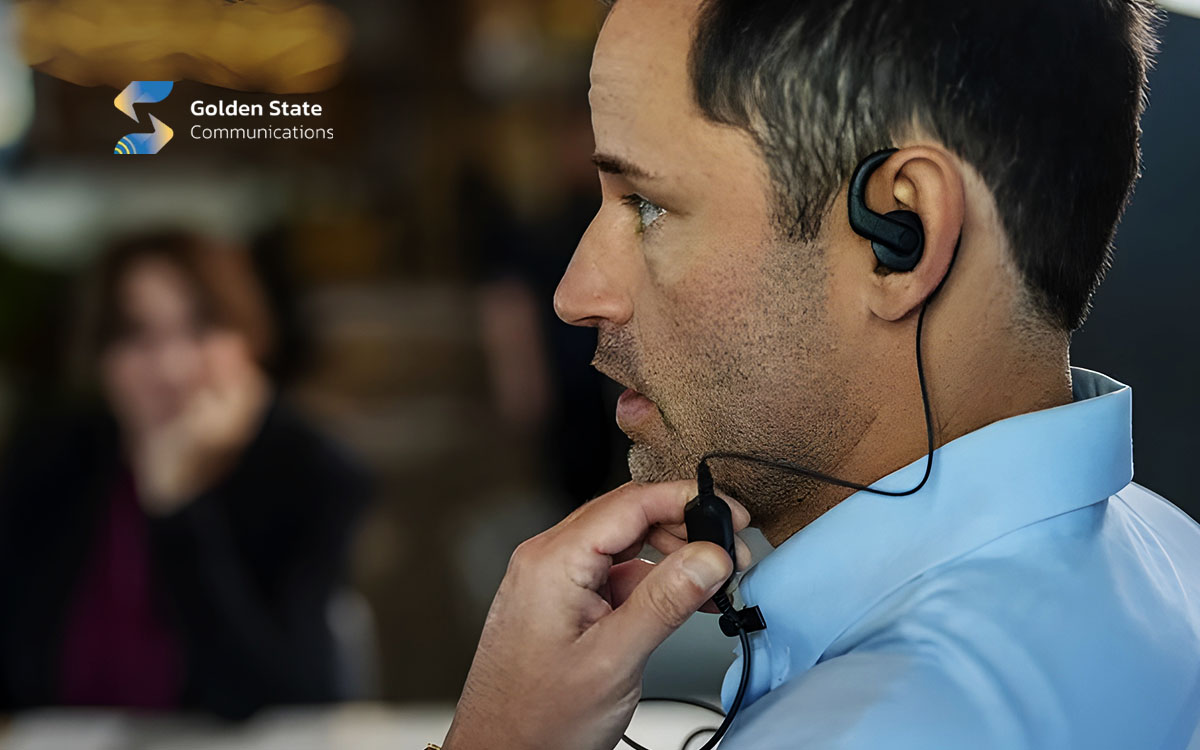
Communication is a critical aspect to plan for, whether you're managing event logistics or maintaining security protocols. Two-way radios provide reliable and instantaneous connectivity, allowing team members to collaborate and get updates in real time.
With several two-way radio models on the market, it can be challenging to determine which one meets your specific needs and operational demands. In this guide, we outline crucial features to consider when selecting a two-way radio model and highlight some options to explore.
Importance of Choosing the Right Communication Channel
The quality and integrity of your communication infrastructure can impact your team's operational effectiveness. The wrong two-way radio model can lead to several communication lapses and failures, including:
- Delayed response times: Unreliable two-way radios can impede swift communication and coordination between teams. In time-critical situations, delays in communication and response times can escalate incidents, reduce operational efficiency, and compromise outcomes.
- Eavesdropping and spoofing: Two-way radio models that lack strong encryption can be intercepted or impersonated, putting your communications and entire operations at risk.
Key Features to Consider When Choosing a Two-Way Radio Model
When selecting a two-way radio model, it's essential to carefully assess factors such as environmental conditions and your specific operational requirements. Regardless of context, certain key features are nonnegotiable for seamless and reliable communication.
Range and Coverage
The range and coverage of a two-way radio determine how far communication can reliably travel without obstruction. Depending on specific operational needs, two-way radios may be used by teams across different floors, large open spaces, or even multiple locations. Various factors, including obstacles, terrain, and structural interference, can directly impact range and coverage.
Consider your operational requirements and coverage area, and choose a model with a suitable range. You can choose between two-way radios with ultrahigh frequency (UHF) or very high frequency (VHF) signals. While VHF signals work better for long distances and open areas, UHF signals are more ideal in areas with structures, such as buildings. Alternatively, you can explore IP-based solutions and leverage the internet or cellular signals to increase range.
Battery Life
The dependability of a two-way radio can be compromised by poor battery life, particularly during extended shifts in professional settings. While it's a sound protocol to have spare batteries available to ensure continuity, it's also advisable to evaluate how long a two-way radio battery can last after a single charge. Additionally, prioritize models equipped with quick charge features for maximum uptime.
Audio Quality
Audio quality is a key feature to consider when choosing a two-way radio model. High-quality audio features enhance overall communication quality. Some key features to look for include:
- Noise cancellation: Two-way radios with noise-canceling features and voice-activated technology provide pristine audio clarity and are more suitable for noisy environments.
- Volume: The volume capability of a two-way radio determines how loud it can get. Evaluate this quality to ensure the audio is loud enough, allowing team members to use it effectively under all operational conditions.
Durability
Due to the inherent demands of event management and security operations, radios are prone to falls and other accidents that can expose them to moisture and dust. When choosing a two-way radio model, opt for those designed to withstand harsh conditions — the best options are radios with high IP ratings of IP67 and above.
Security and Safety
To prevent unauthorized access and interference, opt for two-way radio models with security features such as digital encryption and privacy codes. A better option is to choose licensed radios. With these, you can utilize dedicated frequencies, reducing interference and enhancing operational control.
Beyond communication security, it's crucial to look out for safety features such as GPS location tracking and lone worker mode, as they help ensure the safety of team members and enhance situational awareness.
Types of Two-Way Radios
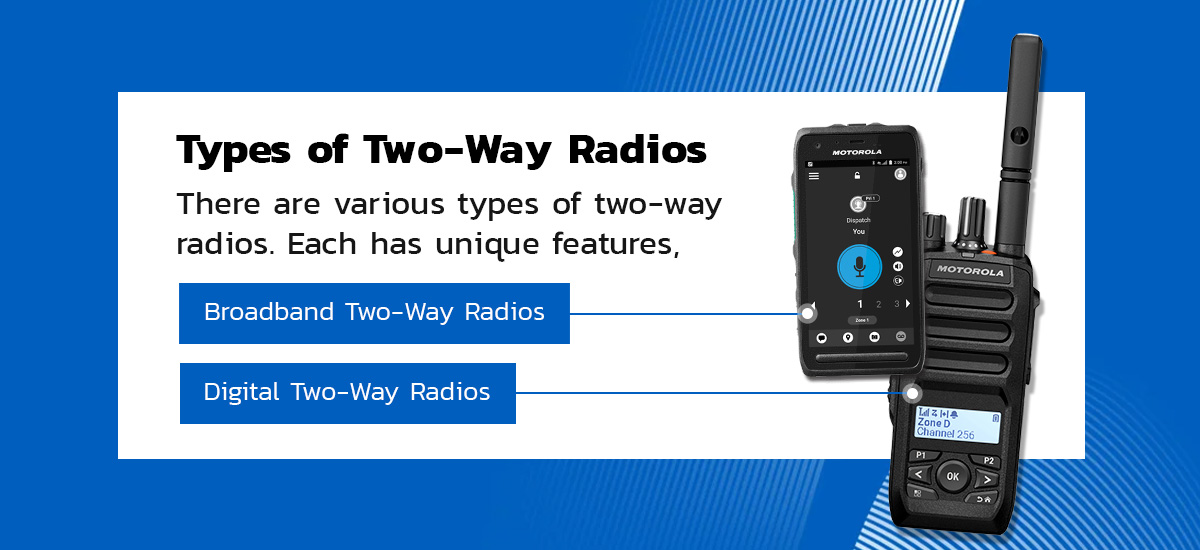
There are various types of two-way radios. Each has unique features, and your choice will depend on your specific needs and use case.
Broadband Two-Way Radios
Broadband two-way radios are also known as push-to-talk over cellular radios. They leverage existing mobile infrastructure and Wi-Fi networks to enable real-time communication across expansive areas. They deliver advanced features comparable to those of a smartphone while maintaining simplicity and durability. Some broadband two-way radio solutions you can explore are:
- Critical Connect LMR Interoperability: Designed to overcome the limitations of traditional interoperability solutions, Motorola's Critical Connect LMR eliminates lengthy deployment times. It enables cloud-based connectivity between LMR systems, broadband push-to-talk, and applications, creating seamless communications.
- WAVE PTX™ Push-to-Talk Service: This solution effectively connects teams across devices, networks, and locations.
Digital Two-Way Radios
These types of walkie-talkie radio models convert voice into digital signals comprising binary codes of ones and zeros and transmit them as a sequence of digital bits. The receiving digital radio, in turn, converts the bits back into a voice signal. They are user-friendly and provide clarity and volume. Motorola has a range of high-quality digital two-way radios, including:
- Motorola MOTOTRBO R2: The Motorola R2 is configurable and can last up to 26.5 hours after a single charge. It also delivers high coverage with a UHF range of 400-480 MHz and a VHF range of 136-174 MHz.
- Motorola MOTOTRBO R5: This model features noise cancellation capabilities and is ideal for use in environments with high background noise. The Motorola R5 can last up to 24 hours and delivers high coverage.
- Motorola MOTOTRBO R7: The R7 model is exceptionally loud and clear, featuring outstanding noise cancellation capabilities. It has a high IP rating of IP68 and can withstand being submerged to a depth of 2 meters for two hours. Additionally, it allows for up to 1,000 channels.
- Motorola Solutions XPR 3000e: The XPR 3000e is a next-generation digital two-way radio with improved expandability, a wide range, and enhanced battery life up to 28 hours after a single charge.
- Motorola Solutions SL3500e: With its stylish and lightweight design, the Motorola SL3500e is both durable and intuitive, featuring several enhancements that improve communication.
- Motorola XPR 5000e: The Motorola XPR 5000e is one of the best Motorola models. It features indoor location tracking and high-performance integrated data.
Equip Your Team With High-Quality Communication Systems
Teams across different sectors require high-quality two-way radios for effective communication and collaboration. When choosing a model for your team, go for quality, reliability, and intuitiveness. Golden State Communications offers a wide range of broadband and digital two-way radios, featuring capabilities that help teams manage day-to-day operations with ease.
Contact our technical support team to learn more about our products and receive assistance in selecting the one that best suits your needs.

Since 1992, Golden State Communications, Inc. and Communications Rental Service have specialized in on-site, 2-way communications solutions. We represent over 5,000 companies and organizations nationwide, including large global tech companies, professional sporting venues, large stadium venues, hospitals, schools, prestigious educational campus institutions, and large music and festival events.

Quick Links
Contacts
Golden State Communications, Inc.
978 Rincon Circle
San Jose, CA 95131
Toll Free: 800-774-6535
Phone: 408-558-2700
Fax: 408-558-2719
Golden State Communications, Inc.
1255 Stone Drive, Suite A
San Marcos, CA 92078
Phone: 619-537-8143
Golden State Communications, Inc.
11175 Azusa Ct, Ste #110
Rancho Cucamonga, Ca. 91730
Toll Free: 866-952-5758